
Clovis Previous Residents Address History Sources
Clovis previous residents are found across an era map. The deed chain is strongest for title. Clovis directories are strongest for listed names and addresses. Census pages supply household relationships through 1950. Sanborn sheets show what structure stood on a Clovis block. Newspapers and probate can mark a death, move, notice, or heir. The coverage table keeps the source roles distinct and shows where to go when an online Clovis path ends.
| Source | Years it covers | Where held | What it shows |
|---|---|---|---|
| Clovis Recorder grantor and grantee index | 1856-1980 historical index; current system after that | Fresno Recorder portal and office | Chain of title, parties, legal description |
| Polk and Clovis county directories | 1871 onward with gaps; Polk 1907-1957 countywide, Clovis again 1973 | Fresno library | Name-to-address evidence |
| Clovis Haines criss-cross | 1972 or 1973 onward | Fresno library | Address-to-listed occupant or telephone |
| Federal census for Clovis | Decennial through 1950 public | NARA and genealogy library | Household, age, occupation, birthplace |
| Clovis Sanborn maps | 1904, 1907, 1912, 1929, updates through 1932 | Library and Library of Congress | Structure footprint, use, and block context |
| Clovis newspapers and probate | 1915-2006 newspapers; probate by case and era | Library and Fresno court Archives | Moves, deaths, heirs, notices |
The Clovis city directory collections page owns the historical shelf details. A single Clovis address-history trail can then move across those collections.
Begin a Clovis Previous Residents Trail with Today's APN
Start with Clovis address geometry, not an assumed occupant. Clovis WebGIS or a county parcel map can locate the site, parcel outline, city line, zoning, and neighboring APNs. Record the APN, subdivision, lot or block, and any Clovis legal-description clue. The county's online GIS does not publish ownership, so the map is the first join, not the final answer.
The Fresno Assessor then supplies the lien-date owner or controller for the Clovis parcel and tax-bill mailing channel through its available access route. The 2025 removal of online APN-to-address matching means the older public search description may no longer work as written. Use the office or a purchased roll when required. Keep the Clovis tax year beside the owner because an assessment fact is time bound.
APN 007-030-08T shows the Clovis county pattern. The map book and page make a stable land key, while a street number or mailing ZIP can change.
- Legal description
- The recorded wording that identifies land by lot, block, subdivision, or metes and bounds.
- Chain of title
- A sequence of recorded transfers linking a present interest to earlier grantors and grantees.
- Situs
- The physical parcel location, distinct from the tax mailing address.
Walk the Clovis Previous Residents Trail from Seller to Earlier Buyer
Once the current Clovis lien-date owner is identified, find the vesting deed in the Recorder's self-service system. Record the grantee, grantor, recording date, instrument number, and legal description, then inspect the image. Search the seller's name as a grantee in an earlier period, constrained by the same Clovis legal description or APN. Repeat until the chain reaches the period needed for the house history.
- Verify the Clovis situs and APN in GIS or a parcel map.
- Obtain the Assessor owner and Clovis mailing clue for the cited tax year.
- Retrieve the current Clovis acquisition deed and write down its legal description.
- Search the prior grantor as an earlier grantee, testing trusts, interspousal transfers, and common-name variants.
- Save each instrument citation and use the next source to test occupancy rather than assuming the owner lived there.
The Recorder offers online search and paid downloads for a Clovis deed, free in-office viewing, and mail orders. Certified copies require the original signature and seal and arrive by mail. A prior owner name is a title fact; Clovis directories and newspapers supply the household layer.
Cross the 1981 Fresno Recorder Divide in a Clovis Previous Residents Trail
The historical Clovis cutoff is a practical one. For 1981 forward, use current portal mechanics when the record is available. For 1856 through 1980, use Fresno's separate grantor and grantee index to obtain the book, page, and year, then view or order the cited entry. A Clovis street name alone is not a safe pre-1981 key because the index is organized around parties and documents.
The Recorder keeps Clovis deeds, deeds of trust, releases, liens, easements, subdivision maps, and more than 200 document types. Regular copies cost $1.50 for the first page and $0.50 for each additional page, with a $1 certification. At the counter, card use adds $2.50. Mail requests require a check or money order and the identifiers. Free office viewing can save a family-history project from buying every possible image.
Use the current Fresno Official Records Search and Copies portal for the modern Clovis starting point, then use the office's historical index when the date demands it.
Clovis note: A deed image can contain a legal description and return information subject to redaction, but a sale price is not guaranteed as a simple result field.
Use Haines for Clovis Previous Residents
Haines Criss-Cross is the main Clovis address-to-listed-occupant path from 1972 or 1973 onward. The library's one-year wording difference should be cited, not silently smoothed over. Read the Clovis street section for the target number, the consecutive numbers around it, and the next available volume. Preserve vacant or missing entries. Then compare the address with the deed chain, a newspaper notice, or a permit date.
Haines gives the Clovis household trail a layer that deeds cannot provide. It is still a directory of listed names or subscribers. An absent Clovis name may mean no telephone subscription, a missed canvass, a newly built address, a coverage change, or a different household listing. Do not turn absence into nonresidence. Past residents are a dated category, not a present address claim.
For the full publisher history and library visit method, use the Clovis city directory page. The Clovis street directory page handles the modern address chain.
Polk's Clovis Previous Residents Gap Needs a Note
Polk-Husted and R.L. Polk give a name-keyed path from 1907 through 1957 for all or most of Fresno County, followed by Fresno-city focus. Clovis listings return in 1973. County directories exist from 1871 but have documented Clovis-area gaps, including 1874-1880, 1885-1888, 1897, 1899, 1930, 1943, 1945-1946, and 1948.
When a Clovis past household disappears, test the collection before testing the family story. Check the county or city coverage, a spelling variant, the next available year, and Haines when the period allows. Pair the printed address with a Clovis legal description or subdivision map. Clovis incorporated in 1912, so early sources may use county or regional wording even when the later parcel sits in the city.
A Clovis directory year can establish a listed name and address. It cannot by itself establish title, every household member, or a present residence.
Clovis Previous Residents Sanborn Maps Show Physical Change
Sanborn maps help separate a changed Clovis structure from a changed occupant. The Clovis set includes February 1904, February 1907, April 1912, June 1929, and revision updates through June 1932. Sheets can show building dimensions, materials, use, utility lines, and block evolution. They do not supply a complete Clovis resident list, but they can prove that a numbered lot or structure existed before a later parcel card.
The rail and lumber history of Clovis makes the early set especially useful. In Old Town and the built-out Clovis core, a Sanborn block can sit beside a county deed, directory, and newspaper issue. In Loma Vista and newer north or northeast growth, subdivision maps, recent deeds, permits, annexation files, and APN changes often carry more weight because older volumes predate the Clovis streets.
Check the library's Clovis Sanborn holdings before relying on a map year.
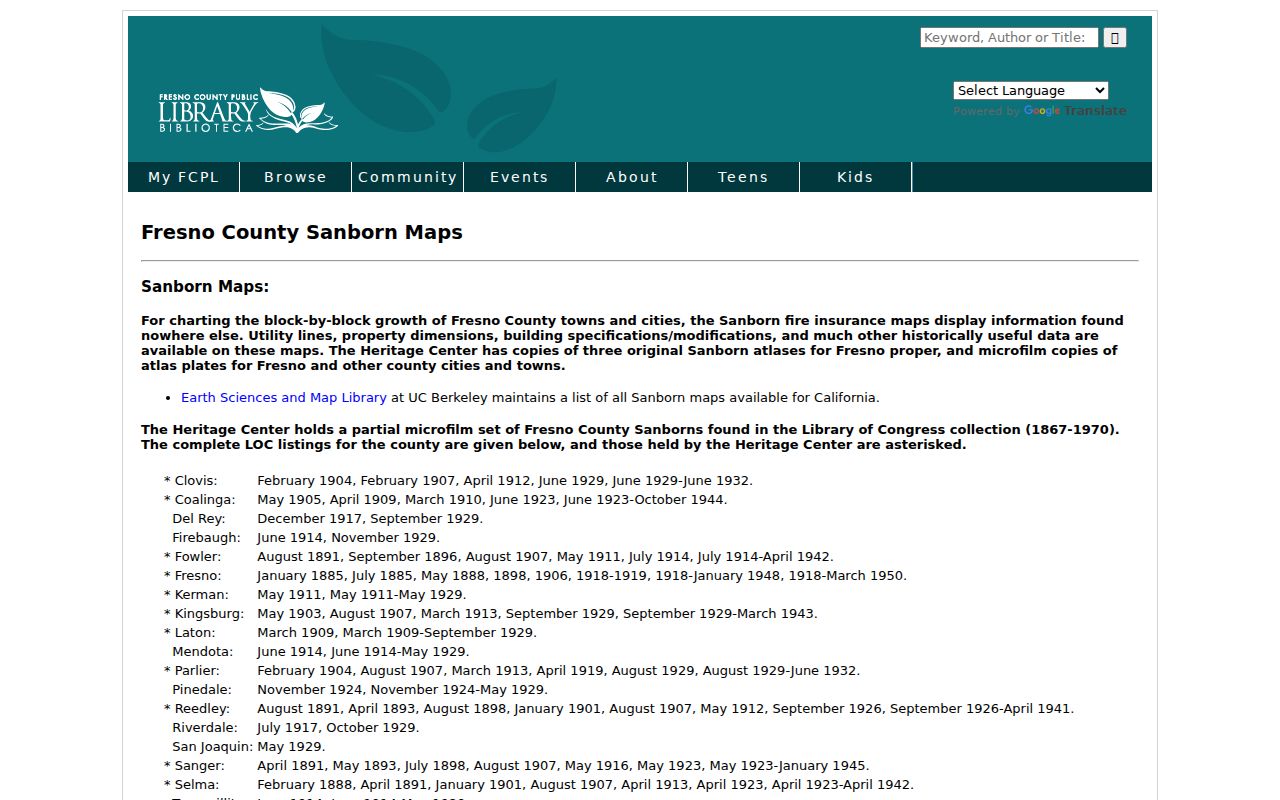
The Clovis Sanborn capture belongs with the map date, sheet, block, and address bridge used in the house history.
Pair Occupants with the 1950 Census
The federal census supplies Clovis household relationships, age, occupation, and birthplace through 1950. The 72-year access rule makes 1950 the newest public census until 2032. A Clovis directory year close to a census year can test whether a listed name belongs to the same household, while a gap between them can reveal a move or a coverage problem.
Use a sequence rather than a single page. Start with the Clovis address in Polk or Haines, match the street and household in the census, then return to the next directory or newspaper. Keep names exactly as printed and do not infer kinship from a surname. A census household is a dated enumeration, not a current address source.
For a family-history question, the Fresno Genealogy and Local History Library can provide staff help and in-library affiliate access to expanded FamilySearch images. NARA and genealogy catalogs supply additional routes when a local reel is not enough.
Permits, Newspapers, and Probate Close Gaps
Clovis permits can date construction, additions, remodeling, inspection milestones, and project parties. They may show an applicant, contractor, or owner at application, but those roles do not prove Clovis residence. The city permit channel, counter, and focused CPRA request are the access paths. Older plans may require inspection or redaction.
Clovis newspaper reels can add moves, marriage notices, obituaries, funeral notices, organizations, and legal postings. The Clovis Tribune covers 1915-1925, and the Clovis Independent covers March 1933-December 2006. Probate petitions and notices can name heirs and addresses, subject to confidentiality and redaction. Fresno Court Archives is the in-person route for a pulled Clovis file.
Use the Clovis newspaper microfilm coverage to set the date range before searching a name.
The California State Archives collection also bridges early Clovis years.
Review California State Archives holdings for Fresno deeds 1875-1900, probate 1880-1920, naturalizations 1856-1934, births 1873-1950, deaths 1878-1950, and marriages 1856-1919.
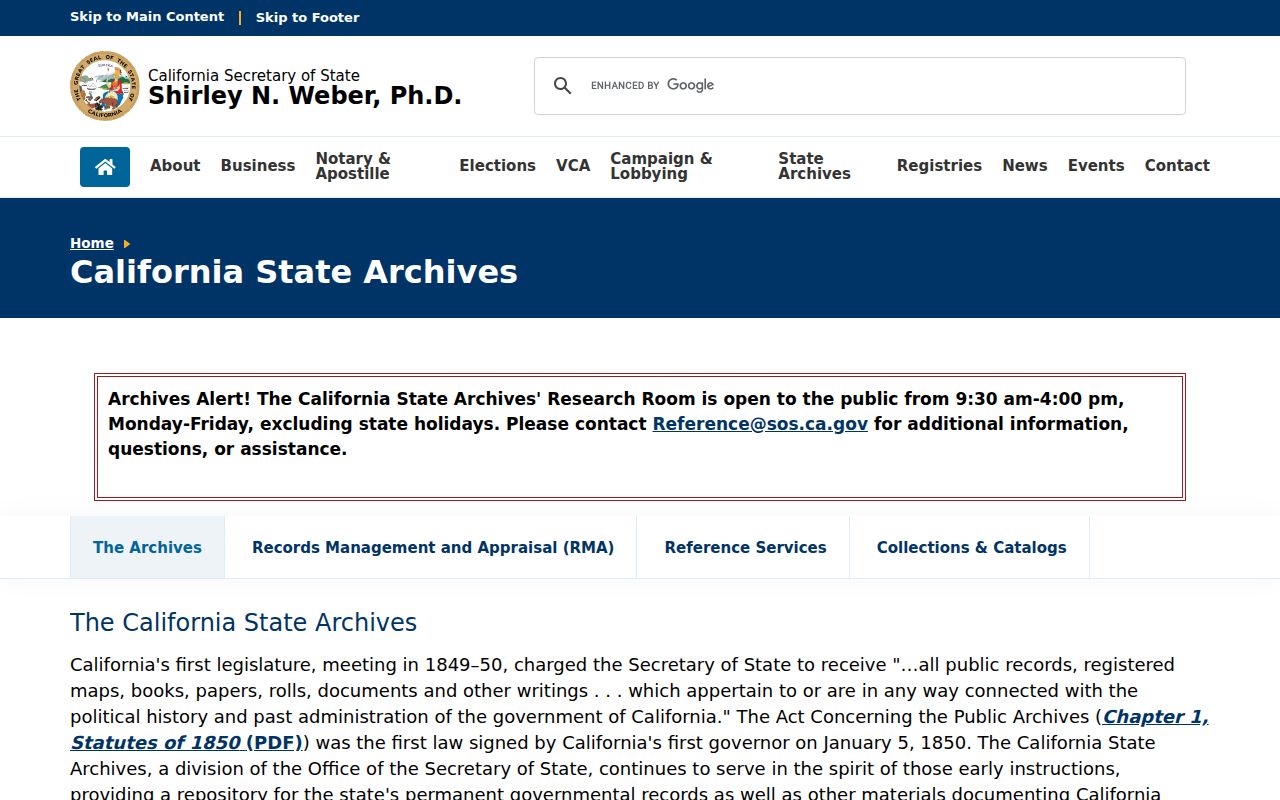
The Clovis archive image is a catalog path; onsite or mediated access rules still apply.
Bridge Clovis Address Changes with Land
No documented Clovis street-renumbering year was found in the research. That missing Clovis fact is a reason to use stable land identifiers, not to invent a conversion. Preserve the APN, legal description, subdivision, lot or block, and Sanborn sheet. Compare the old printed address with the parcel map and deed language. If a Clovis street label changed, the land description may still connect the records.
ZIP changes can create a similar illusion. The 93619 split from 93611 on July 1, 2004, but a Clovis mailing code change does not prove a move. Annexation can change a city custodian while postal delivery persists. A current Clovis city line should be checked in GIS, and a record request should go to the agency with jurisdiction at that date.
These bridges make Clovis house-history research more honest. The trail can say “same parcel, different address label” when the evidence supports it, and “not resolved” when it does not. That restraint protects the meaning of previous residents in a living Clovis neighborhood. A previous residents result should retain its source and year.
Past Households Need Lawful Context
A Clovis house history is a personal and civic use of records when it stays tied to the property, family, or documented event. It should not become a claim about living people based on a stale directory line. Label a person as a former owner, listed occupant, subscriber, party, heir, or newspaper subject. Keep the source and year in the note. A past Clovis household can be historically interesting without being a present-day lead.
Respect the boundary. Previous residents research may support genealogy, estate work, restoration, and local history. Do not use names, addresses, deeds, voter products, or court records to stalk, harass, intimidate, impersonate, or harm anyone.
California Safe at Home participants and confidential records are stopping points. If the record is sealed, redacted, or protected, the lawful answer is that the custodian does not disclose it. That limit is part of a sound Clovis address history, not a Clovis gap to work around.